The work, one phase at a time
- The mural, 2013. Known: the scope, the wall and the client's own art. Unknown: whether there would ever be a second job. The question was whether the mural could be priced and delivered on its own terms, without a word about what might follow. It could. It produced a wall the client could stand in front of and a wall the city drove past every day. What it changed was the basis of the next conversation: the client was evaluating a finished piece of work, and the city had decided it liked a thing it had not been asked about.
- The retail store. Known: the company needed a store on the ground floor of a licensing office, selling the brand to people who came to see the building. The question was what a retail floor inside an occupied working building needs from the contractor, which is mostly hours, dust control and a schedule that respects the office upstairs. It produced the store, open for business and still open when the last release went out in 2017. What it changed was the relationship with Carson's planning staff, which began in earnest here, with ordinary reviews and inspections on an ordinary tenant build-out, the way a contractor's standing in a city is always built.
- Las Vegas, October 2014 to March 2015. A different entity and a different seat. Shelby American, the company that built the cars, moved to a new Las Vegas property; Tellus was not licensed in Nevada and served as owner's representative rather than builder. That engagement has its own report. It belongs on the map here because the foundation's trust in Tellus was one account, not two, and what happened in Nevada was part of why the Gardena work kept growing.
- The museum plan and the first phase of the Snake Pit, 2015 to 2016. Known: the foundation now wanted a plan for the whole building, and a VIP lounge, the Snake Pit, as the first stage of a museum. The question was what to build first inside a plan that did not yet have a museum's budget behind it. The answer was the pieces that let the foundation sell the idea to itself and its guests: models of the building, the future museum and the lounge, put on display, and temporary walls that showed how visitors would move through the space. By August 2016 the lounge itself was half built. Along the way Tellus managed the contracts and the construction on the foundation's behalf, and the foundation's own account of that period, in the release Tellus issued, is that the contract and construction management saved it a significant amount of money. The whole Carson facility program, the museum, the event space, the equipment and the retail store, ran in the range of 8 to 12 million dollars, a separate scope from the Las Vegas relocation. Our part of it was a construction management agreement covering a much smaller portion of that total, and nothing in this report should be read as that total being our fee or our revenue.
- The freeze, 2016. The City of Carson froze all new construction. The Shelby work sat in the middle of it. This is its own chapter below.
- The second phase of the Snake Pit, January 2017. Known: the lounge's finish scope, and the fact that the harder work was structural. The question was what had to be true before the client would let us cut into the part of the building that had been Carroll Shelby's own apartment. What had to be true was three finished phases. It produced the structural modifications, the roll-up door systems, the finish selections, and the bar built into the apartment, with a commercial kitchen, pool tables and indoor and outdoor event space around it, stocked with Shelby-branded beer and wine. The target was the annual Carroll Shelby Tribute and Car Show that spring, which the facility hosted and which had launched the 2016 Shelby Mustang the year before.
The freeze with no exception clause
In 2016 Carson placed a moratorium on all new construction. No exception clause, no application form, no variance procedure. Nobody else was getting out of it. The Snake Pit was half built, and the structural phase that would finish it was ahead of us.
The standard move is to treat a freeze as a legal object and argue with it through counsel: vested rights, prior approvals, the reach of the ordinance. That approach has a flaw the ordinance text hides. A freeze with no exception clause has not removed discretion; it has moved it from a form to a person, and that person's real constraint is not the ordinance, it is their own exposure if the call goes wrong later. A legal brief adds to that exposure. It asks the reviewer to take a position on the law, in writing, against a council that just said no to everyone.
So the packet was not a legal argument. It was built around the question the city was actually asking itself that year, which was how to become a place people drive to, and it answered with what Shelby would add to Carson: press, a name people already knew, an annual car show that filled the street, a destination on the route the city was trying to fill, in a city that was already betting on a racing facility and a stadium. It said so in the city's own terms. Behind that narrative went the record the city could check against its own files: the store it had inspected, the work it had watched go in, the press already printed about the project, and a mural it had decided it liked. Then it was papered completely, every claim with its backup, so that whoever said yes had a file to point to and nothing to take on our word.
I went in person. A packet through counsel leaves no one accountable in the room; a builder the staff already knew, standing there, is someone the city was approving rather than something. Tellus got one of the few exemptions the city granted, and the Snake Pit went on.
| The decision | The other way | What I did, and why |
|---|---|---|
| How to read the freeze | As law, to be argued with | As discretion that had moved to a person; a person needs a reason and a record, not a citation |
| What the ask was about | Our project and our schedule | Carson's own interest: press, a destination, a name on its street |
| What to lead with | A legal position on the ordinance | Work the city had already inspected, press already printed, a wall it already liked |
| How to paper it | A letter | Complete backup behind every claim, so the reviewer carried nothing on faith |
| Who carried it in | Counsel, by mail | Me, in the room |
The value-to-the-city packet
Read what the city is trying to hear that year, in its own documents and its own projects. Write the ask as what the project adds to that. Put the company's record in the city behind it, in the city's own files: delivered work, inspections passed, press already printed. Paper every claim with its backup. Bring it in yourself.
What it produced
The phase map is the result. Four phases over four years for one entity, each one awarded on the last, and a separate engagement in another state for the sister company in the middle of them. No phase was sold ahead of the one before it, and the freeze sits in the middle of the strip because that is where it landed, between a half-built lounge and the structural work that finished it.
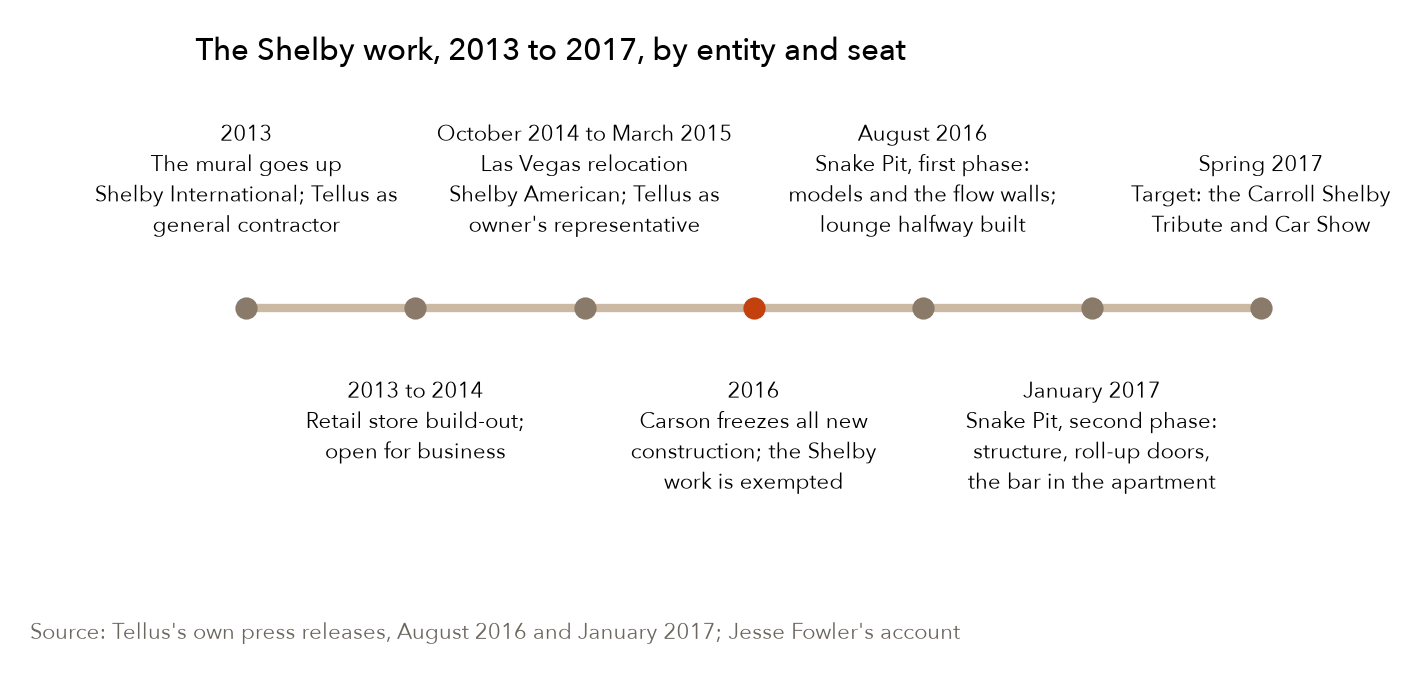
| Phase | When | Entity and seat | What was built |
|---|---|---|---|
| Mural | 2013 | Carroll Shelby International; Tellus as general contractor | The signature, the insignia and the racing stripes on the road-facing wall |
| Retail store | 2013 to 2014 | Carroll Shelby International; Tellus as general contractor | The museum store, open for business |
| Las Vegas relocation | October 2014 to March 2015 | Shelby American; Tellus as owner's representative | The move to a new Las Vegas property, told in its own report |
| Snake Pit, first phase | 2015 to 2016 | Carroll Shelby International; Tellus as general contractor | Models of the building, the museum and the lounge on display; temporary walls showing the visitor flow; the lounge half built by August 2016 |
| Snake Pit, second phase | January 2017 to spring 2017 | Carroll Shelby International; Tellus as general contractor | Structural modifications, roll-up door systems, finishes, the bar in the apartment, a commercial kitchen and event space |
The client's own words, in the release Tellus issued in January 2017: "The Tellus Design Build team earned our trust, and reflects Carroll Shelby's, and America's, true spirit of competition and hard work," from M. Neil Cummings, Esq., Co-CEO of Carroll Shelby International, Inc. A client statement inside the contractor's own release is the weakest form of proof, and I would not lean on it. The phases are the proof. A client does not come back three times for a contractor it has stopped trusting, and it does not hand that contractor the part of the building where its namesake lived.
What we kept, and what we installed
Nothing was installed at the client. The foundation kept its own calendar and released each phase when it was ready to, and a contractor who tries to install a program on a client like that is installing a pitch.
Two things were installed at Tellus, and both are still in use.
The first is the rule that every phase is bid on its own. It was already an instinct; Shelby made it a rule, because it worked on the hardest possible test, a famous client who could have hired anyone. The faulty logic it replaced is the master agreement: a locked rate and a default to the incumbent that protects the contractor's forward revenue by taking the client's freedom to walk. The client can feel that, and the feeling is what a program bid is priced against.
The second is the value-to-the-city packet. I put it in during the freeze, in 2016, because the ordinary method was unusable: there was no form to file and no exception to ask for. What was wrong in the original logic was the assumption that a rule is decided by its text. It is decided by a person, and the person needs a reason the exception serves the city and a record they can check without taking anyone's word. Costa Mesa got the same treatment later on a different problem, the first use permit for an axe-throwing venue in a city whose code had no line for one, and there the order was reversed on purpose: prove the use first by running it, then file with the running venue as the evidence. The packet is the same. What changes is what you are allowed to do before you ask.
That is the limit on the mural rule, and it is worth stating plainly. Forgiveness works when the finished fact is better than the request would have sounded and the cost of being wrong is a coat of paint. It does not work where the thing being decided is safety or use, or where the reviewer's exposure is bigger than yours. A wall can be repainted. A use with a life-safety finding cannot be forgiven after the fact, and a freeze that a council has announced to everyone is not going to be undone by a finished thing on the street. In those cases the finished fact is still the strongest argument you have; it just has to be brought in with the paper behind it and a person to answer for it. The method note attached to this report lays the three cases side by side.
What it cost to hold the line, and what I would watch
Pricing the wall cost forward visibility. For four years there was no signed program, no locked rate and no phase that could not have been rebid to another contractor, including the structural phase, where a bigger firm with more standing could have pitched the whole museum as a package. Every phase we won, we won again. The mural cost a bet: the downside of painting first was a repaint and a bad first impression with the city on a client's building, and that downside was real, not theoretical. The freeze cost weeks of my own time in the middle of a busy year, assembling a record and standing in a room where no one owed us a yes.
What I would watch on a relationship like this one is three things. Structural work inside an occupied legacy space, because the thing you are cutting into is the reason the client cares, and the site knowledge you have built across the earlier phases is the only thing that keeps that from going wrong. The client's own calendar, because a foundation's phases release on its cycle and not on yours, and the temptation to pull the next phase forward is the same temptation as the program bid. And the line between what can be forgiven and what has to be asked. The mural was on the right side of it. Anyone who takes the mural as the whole lesson, and paints first on a use or a structure, has learned the wrong half.
What transfers out of this one is not construction. It is the shape of a relationship with a counterparty that has every reason to be careful: a famous client with no history with you, a city with a rule and no form. In both cases the ask that works is the one sized to what you have already put in front of them, and the thing that earns the next ask is the last one finished well. I have run vendor relationships, city approvals and buy-side conversations on that rule since, and the failure I watch for is always the same one, the program sold before the wall is dry.
A slice of the project list
A few related projects.
- AXT Axe Haus, Costa Mesa: the same prove-it-before-you-paper-it method won the city's first axe-throwing permit.
- Contractor Gorilla: the search strategy that put Tellus Design and Build on page one of Google for design build Los Angeles (2014 to 2017).
- LA Clippers Practice Facility: general contracting and design for a phased redesign that never stopped the team's use of the building (2017 to 2018).
- Habitat for Humanity: construction partner through Tellus across Santa Barbara, Orange County and Los Angeles chapters (2007 to 2016).
- Village San Juan: kept an HOA property management contract on a board vote and rebuilt the operation behind it (2015 to 2022).